
Asim Munir Redefines Deterrence
By Junaid Qaiser
By Junaid Qaiser
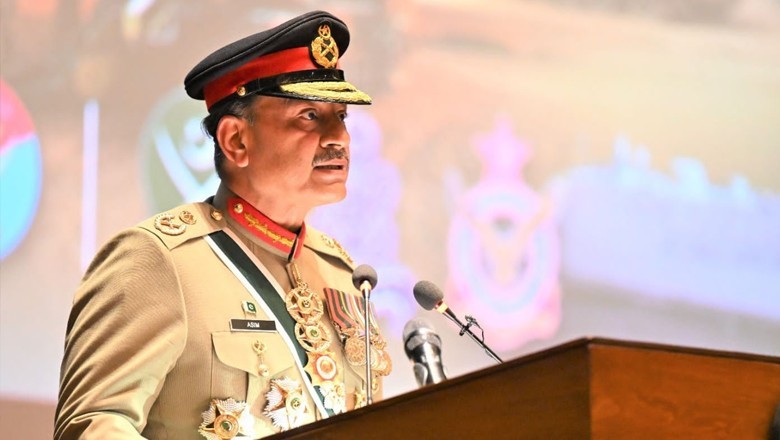
The first address of Field Marshal Asim Munir as Pakistan's Chief of Defence Forces was more than an introductory speech at a point in time when the strategic temperature of South Asia is once again rising. Delivered at GHQ in Rawalpindi before officers of all three services, the remarks carried a clarity that Pakistan's neighbours would be unwise to overlook: the country wants peace, but not at the cost of its sovereignty.
It was a distinctive subtext: Pakistan is reshaping its deterrence posture, and the newly created Defence Forces Headquarters sits at the centre of that shift. COAS and CDF while addressing the officers of the tri services reiterated the extraordinary courage and conviction displayed by the complete Pakistani nation, particularly the professionalism of the valiant men and women of the Armed Forces of Pakistan during Marka-e-Haq. He highlighted that the Multi Domain Operations of Marka-e-Haq have now become a textbook example and case study for future warfare. The COAS & CDF paid deep homage to the martyrs who would always remain the pride of the nation.
To date, Pakistan's decision to unify operational command through the CDF is perhaps the most consequential defence reform since the 1970s. CDF Asim Munir framed the restructuring not as an internal power adjustment but as a strategic necessity. Modern warfare has simply outgrown old models of command. Cyber conflict, information operations, AI-enabled targeting, and space-based surveillance are redefining battlefields faster than the pace of institutional adaptation.
Against this backdrop, his insistence on “tri-services synergy” was not bureaucratic jargon—it was a warning about what happens to states that fail to modernize.
It also came with a reassuring message at home: each service retains its identity and autonomy. Abroad, the message is sharper: a unified and coordinated Pakistani military will respond faster, across domains, and far more precisely than before.
Munir's remarks addressed to India were unusually candid. In a situation when the political rhetoric emanating from New Delhi has begun to habitually belittle capabilities in Pakistan, he clarified that any miscalculation on this score would invite a response "much more swift and severe."
This was not bluster. Pakistan’s brief conflict with India in May—now cited by its own military as a textbook example of multi-domain operations—evidently has shaped the armed forces’ confidence. His tone suggested that Pakistan no longer feels compelled to counter Indian narratives; it is now more interested in ensuring that India cannot misread its resolve.
If deterrence relies on credibility, then Pakistan's top commander was leaving no room for ambiguity.
Field Marshal Munir also saved some pointed language for the Taliban government of Afghanistan. His message was stark: Kabul has to choose between Pakistan and the “khawarij mischief-makers”—a reference to militant groups exploiting Afghan territory to destabilize Pakistan.
For years, Islamabad quietly addressed security concerns with Kabul, hoping for gradual betterment. That patience has clearly thinned. The remarks by the CDF signal a shift away from polite diplomatic reminders and toward firm strategic expectations. Afghanistan, too, has been warned against misreading the moment.
CDF Munir anchored his remarks in a broader national narrative, reminding audiences that Pakistan's resilience lies not only in its military capability but in the "unflinching resolve of a united nation." At a time when the country is under economic pressure and political strain, he seemed intent on reinforcing a sense of coherence and collective purpose.
The symbolism of the ceremony-the tri-services guard of honour, the presence of the service chiefs, the elevation of Munir as Pakistan's first CDF-reinforced this message of institutional continuity and national resolve.
Taken together, Munir's remarks mark a turning point. Pakistan is signaling that it is reorganizing itself for a different era of warfare, one where speed, coordination, and technological adaptability matter as much as traditional strength. A unified command structure means that Pakistan's deterrence will no longer rest on siloed responses; it will be multi-layered, integrated, and far more agile.
For India and Afghanistan, the message is simple: Pakistan is recalibrating, not retreating. And unlike past periods of transition, this is driven by strategic foresight rather than crisis. Munir's address did not ask the region to be alarmed-but it did ask the region to pay attention. Pakistan's military posture is changing, and its deterrence is being reshaped with intent. The neighbours may choose how to respond, but they no longer have the luxury of pretending nothing has changed.



No comments yet.