
Pak-US Deepen Diplomatic Coordination
By Junaid Qaiser
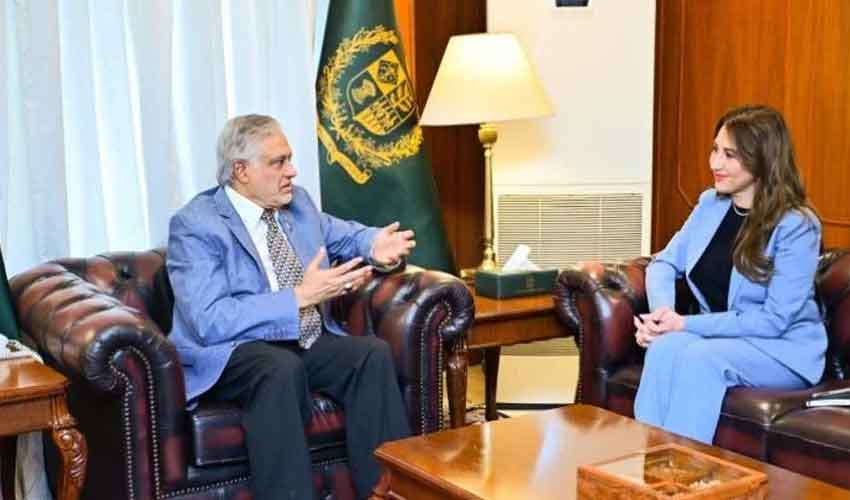
Pakistan and the United States held high-level discussions in Islamabad on Monday as Deputy PM and Foreign Minister Senator Ishaq Dar met US Chargé d’Affaires Natalie A. Baker to review bilateral relations, regional developments and ongoing diplomatic efforts linked to Iran. According to official details, the meeting focused on the evolving regional situation and the broader Pakistan-US bilateral relationship amid growing diplomatic activity in the Middle East and South Asia. The discussions also covered matters of mutual interest and the wider security environment in the region.
The meeting came at a time of heightened international attention on diplomatic engagement between Washington and Tehran, with Pakistan highlighting its role in facilitating communication between the United States and Iran. During the talks, Ishaq Dar underlined Islamabad’s efforts in supporting diplomatic channels aimed at reducing tensions and promoting dialogue. At a moment when the region is once again standing dangerously close to another cycle of confrontation, Pakistan appears determined to present itself not as a spectator, but as a responsible diplomatic actor trying to prevent the situation from spiraling further.
There is a reason why Islamabad’s role matters. The current tensions between Washington and Tehran are not confined to two capitals alone. Every escalation in the Gulf immediately affects oil markets, maritime security, regional economies and political stability across Asia. Countries like Pakistan cannot afford another prolonged crisis in the Middle East. Economic uncertainty, rising energy prices and security disruptions have consequences far beyond the battlefield rhetoric dominating international headlines.
Dar’s remarks reflected a pragmatic understanding of this reality. Pakistan is not attempting to impose itself as a power broker, but rather as a state willing to keep communication channels alive when direct trust between larger actors continues to erode. In modern diplomacy, that role is often more valuable than dramatic public statements. Sometimes preventing silence between rivals becomes the first step toward preventing conflict itself.
The timing of the diplomatic engagement is also significant. President Donald Trump’s rejection of Tehran’s latest response to a proposed settlement framework has deepened fears that negotiations may once again collapse under political pressure and strategic mistrust. Trump’s remarks describing the ceasefire as being on “massive life support” only reinforced the perception that both sides remain deeply divided, not just over policy details but over the broader direction of future relations.
Pakistan’s continued engagement suggests there is still recognition among several countries that escalation is neither inevitable nor beneficial. Islamabad’s contacts with Gulf capitals, the United States and international stakeholders indicate a broader effort to keep diplomacy alive even as military pressure and political tensions continue to rise.
The meeting between Ishaq Dar and Natalie Baker also reflected another important reality: Pakistan-US relations are evolving beyond old frameworks. For years, the relationship was narrowly viewed through the lens of security cooperation and Afghanistan. Today, however, regional diplomacy, economic coordination and strategic stability are becoming increasingly central to bilateral engagement. The discussions in Islamabad highlighted that both countries still see value in maintaining communication despite shifting geopolitical priorities.
Equally noteworthy was Dar’s appreciation of American assistance in facilitating the repatriation of Pakistani and Iranian seafarers through Singapore. While overshadowed by larger geopolitical developments, humanitarian cooperation often reveals the practical side of diplomacy that rarely receives enough attention. In periods of regional tension, even limited coordination on humanitarian matters can help maintain a minimum level of trust between states.
Pakistan’s parallel diplomatic engagement with Saudi Arabia further underlines Islamabad’s balancing approach. Dar’s contact with Saudi Foreign Minister Faisal bin Farhan Al Saud showed that Gulf countries also recognize the dangers of renewed instability around the Strait of Hormuz. Maritime security remains a shared concern because any disruption there would immediately affect global trade and energy flows. Pakistan’s effort to remain engaged with all sides reflects a foreign policy increasingly focused on stability rather than alignment politics.
What Islamabad is doing goes way beyond just routine diplomacy. In a world where major powers are stuck in a cycle of confrontation and distrust, Pakistan has stepped up as a crucial player, actively working to keep the lines of communication open and negotiations alive between Iran and the United States. No doubt it’s a serious regional initiative aimed at preventing another dangerous escalation in the Middle East. By facilitating dialogue, collaborating with Gulf partners, and keeping channels open with both Washington and Tehran, Pakistan is positioning itself right at the heart of efforts to ease tensions and guide the crisis toward conversation instead of conflict.
In many ways, Ishaq Dar’s message was simple: continued engagement is better than confrontation, and communication remains essential even when political differences seem impossible to bridge. In a region exhausted by wars, sanctions and instability, that may be the most sensible position any country can take today.
No comments yet.