
Riyadh and Islamabad: Strategic Solidarity
By Junaid Qaiser
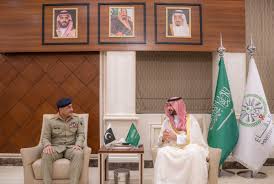
At a time when the Middle East is passing through one of its most volatile phases in recent years, the meeting between Pakistan’s Chief of Defence Forces (CDF) and Chief of Army Staff (COAS) Field Marshal Syed Asim Munir and Saudi Defence Minister Prince Khalid bin Salman Al Saud in Riyadh takes on a meaning that surpasses ordinary diplomatic exchanges. The talks, brought to light a vital reality: when the Kingdom is confronted with security issues, Pakistan is steadfastly by its side.
This meeting occurred amid escalating tensions following a wave of Iranian missile and drone attacks on Saudi territory. These events have raised alarms about a potential larger regional conflict, particularly as the broader Middle East crisis continues to unfold. For Saudi Arabia, these attacks are a direct affront to its security and stability. For Pakistan, they represent a critical moment that tests the strength of one of its most significant strategic alliances..
According to Inter-Services Public Relations (ISPR), both discussed the gravity of security situation accruing from Iranian drone and missile attacks on the Kingdom and joint measures needed to halt them within the framework of Strategic Mutual Defence Agreement.
The Strategic Mutual Defense Agreement between Pakistan and Saudi Arabia was signed on September 17, 2025, amid growing regional instability. The pact stipulates that "any aggression against either country shall be considered an aggression against both," encompassing joint deterrence, enhanced defense cooperation, intelligence sharing, technology transfer, and broader security collaboration.
Field Marshal Asim Munir’s visit to Riyadh served as a clear demonstration of Pakistan’s commitment to standing with Saudi Arabia during these uncertain times. The leadership in Pakistan has repeatedly emphasized that unprovoked attacks against the Kingdom undermine efforts to maintain peace and stability in the region. By engaging directly with Saudi defense leadership, Pakistan reinforced the message that the security partnership between the two nations is both strong and operational.
In a post on social media, Prince Khalid bin Salman shared similar concerns. He highlighted that the talks were focused on Iranian attacks on the Kingdom and the steps necessary to counter them. The Prince pointed out that these actions pose a significant threat to regional security and expressed hope that Iran would act with wisdom, avoiding any missteps that could further destabilize the situation.
The language used by both sides was firm yet measured. While expressing serious concern about the attacks, neither Pakistan nor Saudi Arabia appeared eager to escalate tensions further. Pakistan’s position reflects a delicate but deliberate balancing act. Islamabad shares deep strategic and economic ties with Saudi Arabia, built over decades of cooperation in defence, energy, and financial support. At the same time, Pakistan has traditionally advocated restraint and dialogue in regional disputes, recognizing that prolonged conflict in the Middle East inevitably carries consequences far beyond the region.
On March 3, 2026, during a televised Senate session and a subsequent press conference in Islamabad, Deputy Prime Minister and Foreign Minister Ishaq Dar revealed that he had directly conveyed Pakistan’s position to the Iranian leadership. Dar stated that he had “immediately sensitized” Iranian officials about the Strategic Mutual Defence Agreement, reminding them that Pakistan was “bound by that sovereign agreement.” He explicitly cautioned against attacks on Saudi Arabia, saying, “I made them understand that we have a defence agreement.” His remarks signaled that Islamabad had already moved diplomatically to deter further escalation and to underline the seriousness of Pakistan’s commitments under the pact.
Economic considerations have also entered the equation. With the Strait of Hormuz affected by the ongoing conflict following the US-Israeli strikes on Iran, Pakistan has sought alternative routes to safeguard its energy supply. Islamabad’s request for an oil supply corridor through the Saudi port of Yanbu illustrates how the partnership between the two countries extends into critical economic and logistical domains.
The Riyadh meeting therefore served multiple purposes. It reaffirmed Pakistan’s solidarity with Saudi Arabia, reinforced the credibility of the Strategic Mutual Defence Pact, and conveyed a message that aggression against the Kingdom will not be viewed in isolation. At the same time, it signaled that diplomacy and restraint remain essential to preventing the region from sliding into deeper turmoil.
In moments like these, alliances reveal their true value. The partnership between Riyadh and Islamabad has been shaped by history, shared interests, and a common understanding of regional security. As tensions continue to unfold across the Middle East, that strategic solidarity is likely to remain an important pillar in efforts to preserve stability in an increasingly unpredictable environment.
No comments yet.