
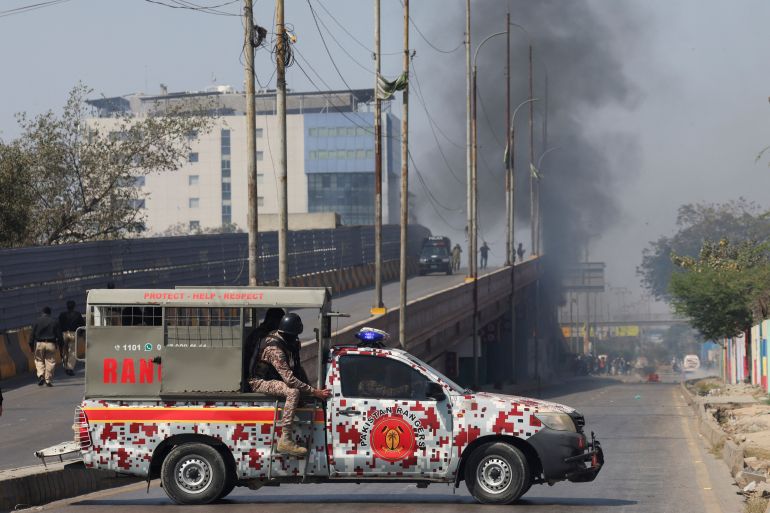
- Pakistan U.S. Consulate Karachi attack revives memories of the 1979 Islamabad embassy burning and exposes recurring security failures.
- Anti-American protests following U.S.–Israel strikes on Iranian leadership escalated into deadly clashes in Karachi.
- Diplomatic missions remain protected under the Vienna Convention, yet repeated breaches weaken Pakistan’s global credibility.
- Political silence and misinformation amplify regional conflicts into domestic instability.
Nearly five decades ago, during the Iranian Revolution led by Ruhollah Khomeini, militants and student protesters stormed the U.S. Embassy in Tehran, triggering the Iran Hostage Crisis and holding American diplomats captive for 444 days. That moment marked a turning point in U.S.–Middle East relations and showed how political upheaval in one country could quickly turn foreign missions into symbolic battlegrounds.
Thank you for reading this post, don't forget to subscribe!Two weeks later, although unrelated to the Iranian revolution, U.S. embassy in Islamabad, Pakistan was ransacked and burned by a violent mob killing several people. It plunged the country into a diplomatic crisis.
Today, Pakistan finds itself confronting a disturbingly similar moment.
As the joint U.S.-Israel strikes took out Iranian revolutionary leadership including Ayatollah Ali Khamenei, angry protesters miles away once again turned their rage toward an American diplomatic mission. This time, the target was the U.S. consulate in Karachi, where clashes with security forces resulted in deaths, injuries, and widespread disruption.
Many are calling those mobsters as martyrs, which they certainly are not. Just like the other attackers on U.S. foreign missions in Pakistan in between these two. Each incident followed regional or global crises. Each reflected anger that originated far beyond Pakistan’s borders. Each demonstrated how quickly diplomatic spaces can become collateral damage. And each exposed religious zeal misused for political gains.
Under the Vienna Convention on Diplomatic Relations, host countries are obligated to protect foreign missions from intrusion, damage, and violence. Diplomatic premises are meant to be inviolable spaces where dialogue continues even in times of crisis.
Embassies and consulates are more than administrative buildings. In moments of geopolitical tension, they become powerful symbols of influence, intervention, and foreign policy. For angry crowds, they often represent distant grievances that feel impossible to confront directly.
When regional crises erupt, particularly those involving the United States and Iran, that symbolic weight becomes combustible. It’s unfortunate that events hundreds of miles away are quickly localized, reframed as personal affronts, and acted upon in streets.
Given the history, it’s a pattern rooted in heightened emotions, sometimes rumors, and certainly political manipulation. Let me remind you that in 2012, militants attacked the U.S. mission in Benghazi, killing Ambassador J. Christopher Stevens and three other Americans. What began as political anger quickly turned into a deadly assault on diplomacy itself.
Under the Vienna Convention on Diplomatic Relations, host countries are obligated to protect foreign missions from intrusion, damage, and violence. Diplomatic premises are meant to be inviolable spaces where dialogue continues even in times of crisis.
When mobs breach these spaces, it reflects not only a failure of security, but also a breakdown in political responsibility and public trust. Pakistan has repeatedly paid the price for such breakdowns like in strained relations, reduced investment, and weakened credibility.
Lessons Unlearned
The 1979 attack in Islamabad followed the chaos of revolutionary change in Tehran. The hostage crisis there and the embassy burning here demonstrated how quickly misleading fervor could spill across borders.
That same fervor is amplified by social media this time. We have experienced that partial information becomes accepted truth. Foreign conflicts are reframed as local battles. The result is tragically familiar: loss of life, institutional damage, and national embarrassment.
Moments like these are tests of political maturity. Too often, silence or ambiguity from political leaders leaves space for extremist narratives to fill the vacuum. Pakistan cannot afford that vacuum. Not repeatedly. The current government, that seems to be closer to the Trump administration, could have subsided the situation more amicably.
Criticism of American policy is legitimate. Protest is a democratic right. Advocacy for justice in the Middle East or elsewhere is morally valid. But attacking embassies and storming consulates is neither principled nor effective. It undermines Pakistan’s sovereignty, weakens its diplomatic position, and harms its own citizens first.
The connection between Islamabad in 1979 and Karachi in 2026 is not a coincidence. It is a warning for the political leadership! From the ashes of the embassy in Islamabad to the clashes in Karachi, the lesson is clear: allowing foreign crises to erupt on our streets serves no national interest.
The choice now is whether we continue to repeat this history or finally learn from it, because a country that keeps mistaking rage for resistance and destruction for dignity will forever remain hostage that too not to foreign powers, but to its own unresolved anger.
Anila Ali is a civil rights advocate, educator, and philanthropist dedicated to challenging stereotypes and combating bigotry. As a Muslim leader and activist, she works tirelessly to empower women, promote religious freedom, and counter violent extremism. The views expressed here are her own and do not necessarily reflect those of the Peoples Voice
No comments yet.