
The Drift of Pashtun Nationalism: From Principle to Pragmatism
By Quraysh Khattak
For decades, Pashtun nationalism dominated the political imagination of Pakistan’s northwest. It was a movement grounded in the high-minded ideals of constitutionalism, federalism, and a stubborn resistance to the heavy-handed centralization of the state. To be a Pashtun nationalist was to subscribe to a coherent political philosophy, one that championed the periphery against the center and the parliament against the barracks.
Today, however, that foundation feels hollow. The crisis currently gripping Pashtun politics is not merely one of state repression, systemic marginalization, or the chronic underdevelopment of Pashtun-inhabited areas in both Khyber Pakhtunkhwa and Balochistan, though those remain agonizingly real.
The most consequential crisis is internal: a profound and growing ideological confusion. What was once a principled movement for rights and autonomy has increasingly transformed into a series of transactional alliances, leaving the traditional nationalist guard adrift, opportunistic, and increasingly incoherent.
Historically, Pashtun nationalist parties framed their political maneuvers as tactical necessities rather than ideological surrenders. The Awami National Party (ANP), the standard-bearer of the Bacha Khan legacy, spent years defending its partnerships first with the Pakistan Peoples Party (PPP), then the Pakistan Muslim League-Nawaz (PML-N), and eventually circling back to the PPP.
At the time, these alliances were defensible. They were housed within a broadly liberal-democratic framework. When the ANP stood with the PPP, they did so under the banner of the 18th Amendment and provincial autonomy. When they leaned toward the PML-N, they invoked the sanctity of civilian supremacy. These were "marriages of convenience," but the partners at least spoke a similar language of parliamentary democracy.Yet, even then, the rot was setting in. By entering the corridors of power alongside mainstream parties deeply embedded in patronage networks, Pashtun nationalists diluted their narrative of resistance. Governance replaced struggle; the perks of the ministry displaced the principles of the movement. Over time, the electorate - particularly the youth - stopped seeing nationalists as a transformative alternative. Instead, they began to see them as just another elite faction, haggling over their share of the provincial and federal pie.
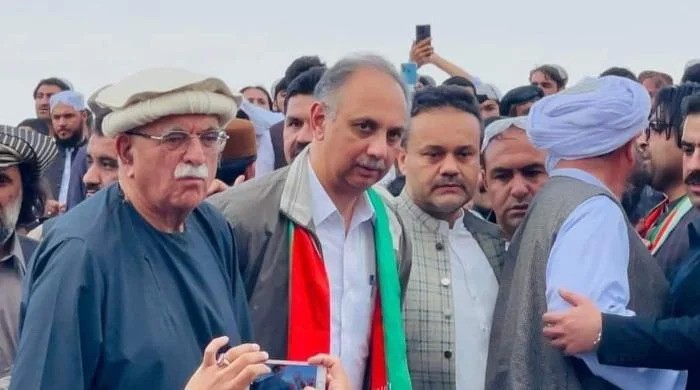
If the ANP’s alliances with the PPP and PML-N were dilutions, the current alignment of Mahmood Khan Achakzai with the Pakistan Tehreek-e-Insaf (PTI) represents a total rupture. The decision of the veteran Pashtun nationalist leader to align with the PTI is not merely a tactical shift; it is an ideological somersault that defies historical gravity.
The PTI is a party whose DNA is fundamentally at odds with the traditional tenets of Pashtun nationalism. It rose to power on a wave of populism and institutional engineering. Its political model is deeply centralized, built around a cult of personality rather than the strength of democratic institutions or ideology. Furthermore, the PTI’s brand of nationalism is majoritarian and often dismissive of the nuances of ethnic rights and provincial autonomy that form the bedrock of the nationalist cause.
For a leader like Achakzai, who has spent a lifetime positioning himself as the ultimate defender of parliamentary supremacy and the rights of smaller provinces, to stand as a primary ally to the PTI raises existential questions. What remains of Pashtun nationalism if it can comfortably coexist with a political force that has repeatedly undermined the parliament, empowered unelected institutions, and reduced complex political discourse to mere spectacle?
The defense offered by supporters is often framed as "political realism" in a landscape where the old rules no longer apply. But realism stripped of ideological anchors is indistinguishable from political expediency. When nationalists prove they can ally with anyone, from the left to the right to the populist center, the message to the voter is clear: ideology is a negotiable commodity; power is the only fixed point.
This ideological vacuum has created a chasm that is being rapidly filled by others. A younger generation of Pashtuns, disillusioned by the perceived hypocrisy of the "old guard," is looking elsewhere for leadership. The numbers tell a story of a shifting tide. In recent electoral cycles, traditional nationalist parties have seen their vote shares stagnate or dwindle in key constituencies. While the ANP and PkMAP (Pashtunkhwa Milli Awami Party) struggle to maintain their footing, grassroots movements rooted outside the parliamentary system have captured the imagination of the youth.
These movements offer a moral clarity that the established parties have traded away. They speak directly to the grievances of the "war on terror" generation, disappearances, landmines, and economic disenfranchisement, without the filtered language of coalition politics. The decline of electoral nationalism in the Pashtun belt is not an accident of fate; it is an earned outcome. When parties stop representing a distinct idea and start representing a mere interest group, they lose the moral authority required to mobilize a population that has suffered as much as the Pashtuns have.
The current moment reflects a deeper fatigue with the status quo. If the nationalist leadership continues to prioritize seat-adjustment formulas over political substance, they risk becoming historical curiosities, relics of a time when identity meant more than a bargaining chip. Pashtun nationalism today stands at a precarious crossroads. It can either continue its slide into irrelevance, acting as a vestigial ethnic label attached to whoever happens to be the strongest challenger to the establishment at any given moment, or it can undergo a painful process of introspection and rediscover a principled political identity.
A revived Pashtun nationalism must be more than a grievance-based movement. It must return to its roots of decentralization, social justice, and democratic consistency. This means moving beyond mere rhetoric and power-sharing deals to demand true fiscal and administrative power for the provinces and addressing the internal class hierarchies that have allowed nationalist parties to become the domain of landed and business elites.
____________________
About the writer: Quraysh Khattak is a development practitioner and a former journalist. He writes on the intersections of political culture, governance, and institutional reform.
No comments yet.