
Rethinking US Visa Curbs
By Junaid Qaiser
By Junaid Qaiser
Recent engagement between Pakistan and the United States in Washington reflects a promising and meaningful shift in how the relationship is being approached—measured, constructive, and forward-looking. At the center of these discussions is the issue of US visa restrictions on Pakistani nationals, a matter that both sides now appear willing to revisit with greater nuance and understanding.
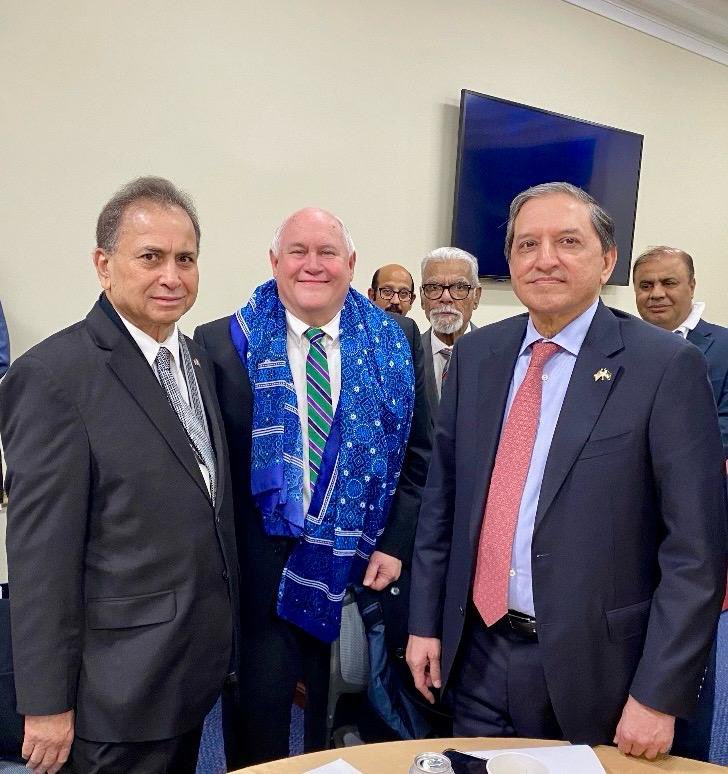
A high-level Pakistani parliamentary delegation, led by Senators Saleem H. Mandviwalla and Rana Mahmoodul Hassan, travelled to Washington with the aim of strengthening legislative ties and addressing practical concerns affecting bilateral relations. Their message was clear and balanced: visa-related hurdles have created avoidable difficulties for ordinary Pakistanis and have limited people-to-people exchanges that traditionally form the backbone of long-term strong and sustainable partnerships.
Rather than framing the issue as a grievance, the delegation presented it as an opportunity for reassessment. Senator Mandviwalla noted that Pakistan’s placement among countries facing heightened visa scrutiny does not accurately reflect the country’s current trajectory or its contributions to regional and global stability. He also highlighted an often-overlooked reality: Pakistani Americans are among the most industrious and economically successful communities in the United States, contributing positively to society across business, medicine, academia, and technology.
This view was reinforced by Dr Gholam Mujtaba of the Pakistan Policy Institute USA, which organized the visit. He pointed out that the Pakistani diaspora ranks among the most prosperous demographic groups in the country—a fact that challenges outdated assumptions and supports the case for a more facilitative visa regime. Even guidance shared by the US ambassador in Islamabad has encouraged lawmakers to communicate these facts clearly to Congress.
The meetings at the Rayburn House Office Building were notable not only for their substance but also for their tone. US lawmakers, including Representatives Ron Estes, Al Green, Tom Suozzi, Josh Gottheimer, and Laura Gillen, welcomed the delegation’s emphasis on dialogue over politics. The Pakistani senators were careful to underline that their visit was strictly non-partisan and focused on constructive engagement, a clarification that helped build confidence and trust.
Encouragingly, these interactions produced tangible outcomes. Representative Al Green’s agreement to form a Pakistan Strategic Bipartisan Caucus signals growing interest in sustained parliamentary-level cooperation. Such platforms can help ensure continuity in Pakistan-US relations beyond changes in administrations and shifting global priorities.
The visa discussion is also unfolding against a broader backdrop of improving Pakistan-US ties. According to international observers, Pakistan has re-emerged in Washington as a reliable and pragmatic partner. Counterterrorism cooperation has been restored, a major trade agreement reducing tariffs was finalized in mid-2025, and collaboration in energy development has been announced. The recent US approval for upgrading Pakistan’s F-16 fleet further reflects renewed confidence in the partnership.
In this context, rethinking US visa curbs is less about reversing policy and more about aligning it with present realities. Easing restrictions would encourage educational exchange, business travel, and cultural engagement—areas where both countries stand to benefit. It would also send a positive signal that the relationship is evolving from transactional necessity to strategic choice.
The discussions in Washington suggest that such a reassessment is possible. If approached with the same spirit of cooperation shown during this parliamentary engagement, progress on visas could become another step toward a more balanced, inclusive, and resilient Pakistan-US relationship—one rooted in mutual respect and shared interests rather than inherited perceptions.
No comments yet.