
Honours, Trust, and Strategy: The New Momentum in Pakistan–Jordan Relations
By Junaid Qaiser
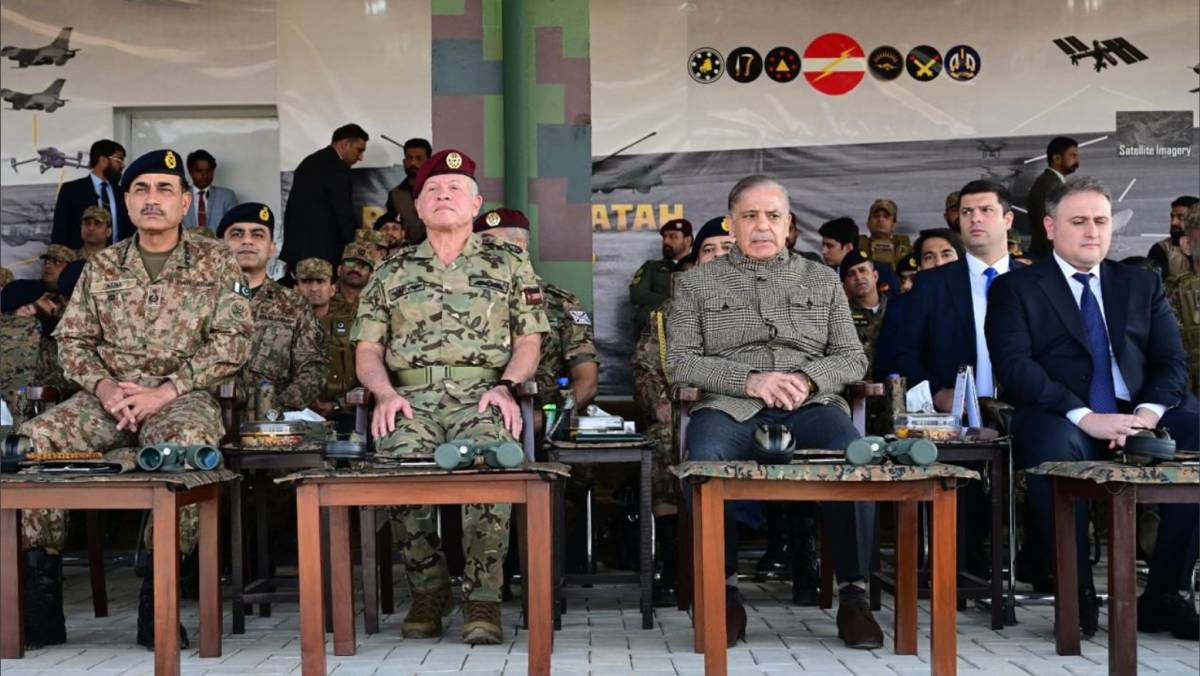
King Abdullah II’s recent two-day visit to Pakistan was notable not only for its substance but also for its symbolism, marking a significant moment in the evolving relationship between the two countries. Far from being a routine diplomatic engagement or a perfunctory exchange of formalities, the visit carried a weight of renewed trust, shared regional concerns, and a mutual pledge to pursue stability in a turbulent era. With the Middle East and South Asia both experiencing heightened tensions and uncertainties, the strengthening of the Pakistan–Jordan bond emerges as a beacon of measured cooperation and strategic partnership.
This was not a solitary visit by King Abdullah; he was accompanied by Princess Salma and a high-level delegation of senior Jordanian officials, underlining the importance the Kingdom attaches to this bilateral relationship. Throughout his stay, King Abdullah held significant meetings with Prime Minister Shehbaz Sharif, President Asif Ali Zardari, Azerbaijan’s defence minister, and, crucially, Chief of Army Staff Field Marshal Asim Munir. These engagements were not limited to ceremonial exchanges; they were substantial, with the delegation attending briefings at the Global Industrial and Defence Solutions (GIDS) facility before moving to the Tilla Field Firing Ranges for live demonstrations. Every aspect of this meticulously planned visit delivered a powerful message: Pakistan and Jordan are not only reaffirming their historic defence partnership but are also exploring its contemporary relevance and future potential.
King Abdullah’s remarks about Pakistan’s military were especially telling. He offered genuine and pointed praise, commending the Army and Air Force for their “exceptional training, professionalism, and operational readiness.” Such accolades carry weight coming from a monarch who has championed modernization and discipline within his own armed forces. The GIDS session further reinforced this impression, as Pakistan showcased its significant advancements in indigenous defence technology and manufacturing capabilities. These were not simple displays—they were invitations to collaborate further, highlighting Pakistan’s readiness to serve as both a partner and a hub for joint technological advancement. The subsequent visit to the Tilla Field Firing Ranges brought this partnership into sharp relief, as dignitaries observed sophisticated multi-domain joint military exercises. The demonstrations—encompassing ground manoeuvres, spectrum warfare, and coordinated drone operations—underscored the evolution and maturity of Pakistan’s military doctrine, revealing a force prepared for contemporary challenges and open to cooperative innovation.
Symbolism was woven into the visit at every turn. King Abdullah’s decision to bestow the Order of the Military Merit of First Degree upon Field Marshal Munir was an act that transcended mere personal tribute; it signaled deep institutional trust. In a reciprocal gesture, President Asif Ali Zardari conferred the Nishan-i-Pakistan on King Abdullah at an official ceremony held at Aiwan-e-Sadr. King Abdullah, in turn, honored the Pakistani president with the Bejewelled Grand Cordon of Al-Nahda, a rare and prestigious award. These exchanges were not simply protocol—they were meaningful affirmations of a relationship tempered over decades and now poised to meet the demands of a rapidly changing global landscape.
Field Marshal Munir spoke of “strong military ties” and a unified vision for a stable and peaceful region, emphasizing the enduring strategic logic that underpins the relationship. Prime Minister Shehbaz Sharif’s remarks highlighted the “enduring friendship and mutual trust” that have characterized Pakistan–Jordan relations for years. These statements were more than diplomatic niceties; they reflected a convergence of interests and values. Both nations have consistently advocated for peace and justice in their respective spheres—Jordan with its resolute support for the Palestinian cause, and Pakistan with its enduring commitment to a just and equitable regional order. Their alignment is rooted not only in shared strategic objectives but also in deeply held values. King Abdullah has won international admiration for his calls for moderation and justice, particularly in the context of Gaza, and Pakistan stands shoulder to shoulder with him on these core issues.
What is most striking about this visit is that it did not signify the beginning of a partnership, but rather its reinvigoration. The visit served as a powerful reminder of why cooperation between Pakistan and Jordan has weathered decades marked by shifting alliances and regional upheavals. Defence collaboration, technology transfer, diplomatic alignment, and genuine people-to-people goodwill are all converging once again, creating new momentum for the relationship. The exchange of medals and honors, while significant, was not the true milestone of this visit. Rather, it was the tangible sense on both sides that Pakistan and Jordan now see each other as steadfast, principled partners—committed allies ready to confront a turbulent world together, bound by mutual trust and a shared vision for lasting peace and stability.
This renewed partnership is not just an affirmation of past ties; it is a blueprint for the future. As both nations navigate the complexities of their regions and the broader international system, their cooperation in defence, diplomacy, and technological innovation will likely become a model for other bilateral relationships. The clear and public commitment to mutual trust, strategic alignment, and principled action positions Pakistan and Jordan as important contributors to regional peace and security, capable of shaping outcomes in an increasingly interconnected and unpredictable world.
No comments yet.