
PPP Reaffirms Support for 27th Constitutional Amendment, Pledges to Protect Provincial Financial Rights
PPP Reaffirms Support for 27th Constitutional Amendment, Pledges to Protect Provincial Financial Rights
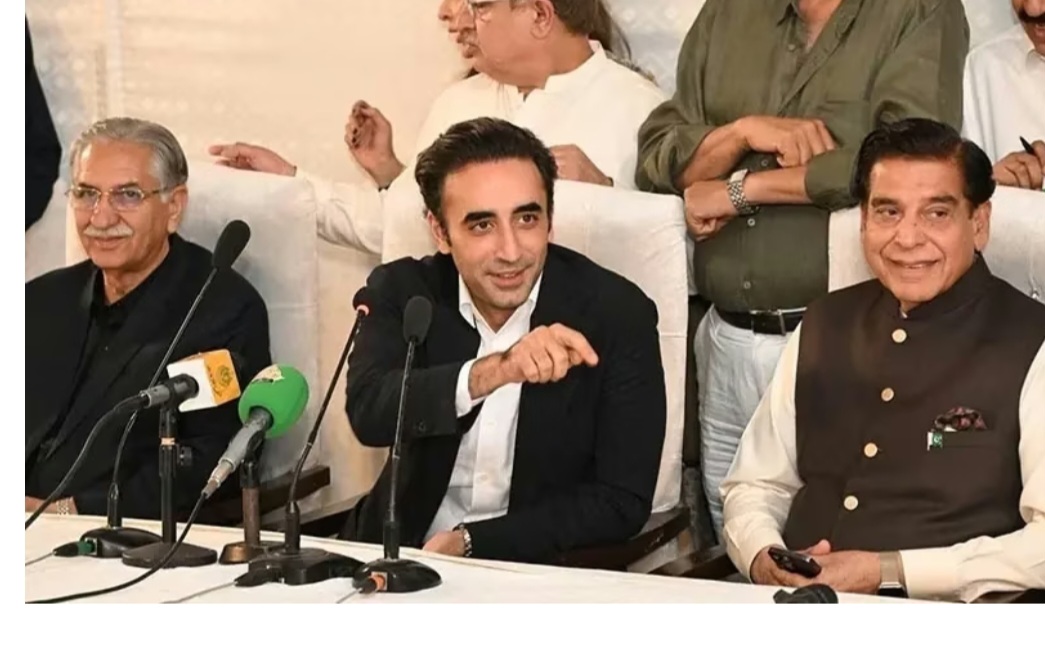
KARACHI: Chairman of the Pakistan Peoples Party Bilawal Bhutto Zardari has reiterated his party's firm backing for the amendment to Article 243 under the government's proposed 27th Constitutional Amendment, signaling the PPP's continued commitment to constitutional reforms while drawing a clear line on protecting provincial financial autonomy.
Speaking at a press conference following the conclusion of the second day of the party's Central Executive Committee meeting, Chairman Bilawal made it unequivocally clear that the PPP would lend its full support to the government's proposed amendment to Article 243. According to a press release issued by the Media Cell at Bilawal House, the party chairman stated that the PPP would not only vote in favor of the amendment but also believed it to be both appropriate and justified in every respect. He noted that following Pakistan's recent victory against India, the government's decisions had brought respect to the country, and now that these measures were being given constitutional and legal cover, the PPP stood ready to offer its complete support.
The PPP chairman emphasized that while his party remained committed to supporting the amendment, it would also engage in meaningful dialogue with the government on other critical matters, including the establishment of a Constitutional Court and the implementation of various unfinished agendas outlined in the Charter of Democracy. However, Chairman Bilawal was emphatic in declaring that the PPP would never retreat from its position of defending the constitutional protections afforded to the provinces regarding their financial shares, making it clear that this remained a non-negotiable principle for his party.
Addressing the concept of a Constitutional Court, Chairman Bilawal explained that this initiative was not merely a recent talking point but had been a fundamental part of the PPP's election manifesto and was also a key component of the Charter of Democracy. He stated that in principle, the PPP supported the idea of establishing Constitutional Courts, but he also pointed out that there were numerous other unfinished agenda items from the Charter of Democracy that deserved attention. The chairman expressed his hope that the party would engage with the government to explore which of these remaining points could be advanced through consensus building and mutual agreement.
Chairman Bilawal suggested that it would be a welcome development if the process of implementing the 27th Constitutional Amendment could also serve as an opportunity to reach consensus on other pending items from the Charter of Democracy. He indicated that his party viewed this as a chance to make meaningful progress on multiple fronts simultaneously, rather than focusing on a single issue in isolation.
On the matter of High Court judge transfers, the PPP chairman outlined the government's proposal to abolish the current process of approval and consultation, which would instead assign this authority to a Parliamentary Judicial Committee. He explained that according to the Constitution, the President of Pakistan currently proceeds with the transfer of a judge based on the approval of the concerned judge and following consultation with the Chief Justices of the two relevant High Courts. While welcoming the inclusion of Parliament's role in the process of judicial transfers, Chairman Bilawal offered a constructive suggestion to the government. He advised that while the President should indeed initiate the process, the Chief Justices of the relevant High Courts should also be made voting members of the Judicial Committee. He further proposed that the committee could summon the judge being transferred to hear their opinion directly, arguing that if the final decision on a judge's transfer were made by this forum, it would render the entire process more transparent and accountable.
However, Chairman Bilawal also acknowledged areas where consensus remained elusive. He revealed that the Central Executive Committee meeting could not reach agreement on several proposals, including those related to dual nationality, the Election Commission, and executive magistracy. Consequently, he stated that he was not in a position at this time to either vote for or support those particular constitutional proposals on behalf of his party, demonstrating the PPP's careful and deliberate approach to constitutional matters.
In response to questions from journalists, Chairman Bilawal underscored the PPP's unwavering commitment to protecting provincial financial rights. He pointed out that the Constitution clearly stipulates that the provinces' share in the National Finance Commission Award can be increased but never decreased. He delivered a strong message that as long as the PPP remained represented in Parliament, it would continue to defend the constitutional protection granted to the provinces' financial shares without exception or compromise.
The PPP chairman also highlighted his party's prioritization of the local government system, noting that the constitutional protection granted to local government elections existed precisely because of the PPP's advocacy. He reiterated his party's longstanding opposition to non-party-based local government elections and proudly stated that Sindh's local government system, when compared to other provinces, enjoyed greater political, administrative, and financial autonomy. Chairman Bilawal clarified that when the Pakistan Muslim League (Nawaz) had approached the PPP for support on the 27th Amendment, there had been no discussion regarding the local government system, indicating that this remained a separate matter.
Addressing concerns about the amendment's potential impact on executive authority, Chairman Bilawal assured that the 27th Constitutional Amendment would have no impact whatsoever on the powers of the President or on the principle of civilian supremacy. He stated that whatever economic challenges the federation might be facing, the PPP wished to see them resolved through proper dialogue, but emphasized that the government would have to engage with his party based on facts and substantive discussion rather than assumptions or political rhetoric.
The chairman strongly rejected the impression that the 18th Amendment had created difficulties for the federation, providing historical context to support his position. He explained that during the previous PPP government, the National Finance Commission Award was implemented first, and only afterward was the 18th Constitutional Amendment passed. He further elaborated that despite the additional responsibilities assigned to the provinces under the 18th Amendment, their financial resources had not increased proportionally to match these new obligations. Chairman Bilawal pointed out that relevant forums such as the Council of Common Interests and the National Finance Commission existed specifically for conducting discussions on these important matters, suggesting that these platforms should be utilized effectively.
In a lighter moment during the press conference, when asked about Maulana Fazlur Rehman, Chairman Bilawal stated that the religious leader would be warmly welcomed whenever he wished to visit, demonstrating the PPP's openness to dialogue across the political spectrum.
No comments yet.