
From Digital Corridors to Quantum Valley
By Junaid Qaiser
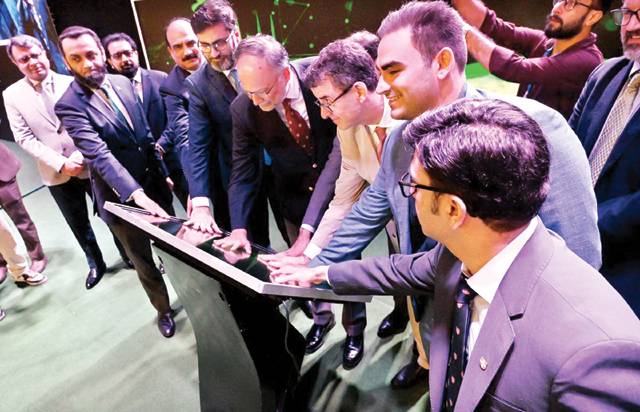
Only a day after writing about how the new Silk Road is increasingly being built through data, artificial intelligence, and digital connectivity rather than caravans and cargo, another development emerged that deserves national attention. The launch of Quantum Valley Pakistan in Islamabad may well prove to be one of the most important technology initiatives in the country's recent history.
Pakistan has often spoken about innovation. It has frequently discussed the potential of its young population. Governments have repeatedly promised to transform the economy through knowledge, technology, and entrepreneurship. What has often been missing, however, is a practical mechanism capable of connecting talent, investment, academia, industry, and global expertise within a single ecosystem. Quantum Valley Pakistan seeks to fill that gap.
The comparison with Silicon Valley is ambitious, and some may argue that it is premature. Silicon Valley was not built overnight. It emerged through decades of investment in education, research, venture capital, innovation culture, and collaboration between universities and industry. Yet every major technology hub in the world began with a vision. The question is not whether Pakistan can replicate Silicon Valley exactly. The more relevant question is whether Pakistan can create its own model that leverages its strengths and responds to its unique challenges.
The launch of Quantum Valley Pakistan suggests that policymakers are increasingly thinking in those terms.
What makes this initiative particularly noteworthy is the calibre of international partners involved. The participation of California-based venture capital giant Plug and Play and the Cambridge Innovation Center (CIC), one of the world's leading innovation ecosystem builders, provides the project with a level of international credibility that few Pakistani technology initiatives have previously enjoyed. These are organizations with extensive experience in helping startups scale, connecting entrepreneurs with investors, and building innovation networks that generate real economic value.
For Pakistan's young entrepreneurs, researchers, engineers, and innovators, this matters enormously. Access to global mentorship, international markets, venture funding, and innovation networks has often been one of the greatest barriers to growth. Many talented Pakistanis possess world-class ideas but lack the ecosystem required to transform those ideas into successful businesses. Quantum Valley aims to bridge that gap.
Federal Minister for Planning, Development and Special Initiatives Ahsan Iqbal was right when he described the initiative as a new pathway for Pakistan's future. The global economy is undergoing a profound transformation. Economic power is increasingly determined not by the size of a country's territory or even its natural resources, but by its ability to generate knowledge, develop technology, and commercialize innovation.
In the twentieth century, nations competed through industrial capacity. In the twenty-first century, they compete through intellectual capacity.
Countries that produce cutting-edge technologies, artificial intelligence applications, advanced manufacturing solutions, biotechnology innovations, and digital platforms are creating disproportionate economic value. Those that remain dependent on importing technology will struggle to keep pace.
This reality makes Quantum Valley Pakistan more than just another technology park or startup initiative. It is part of a broader effort to reposition Pakistan within the global knowledge economy.
The timing is also significant. Pakistan has recently gained international attention for developments in diplomacy and national security. Yet as Ahsan Iqbal correctly observed, strategic achievements ultimately require economic strength to sustain them. Nations earn lasting influence when they combine diplomatic credibility, security capabilities, and economic resilience.
History offers many examples of countries that achieved military or political successes but failed to translate them into long-term prosperity. The real challenge for Pakistan today is not merely defending its interests but creating wealth, jobs, exports, and opportunities for future generations.
This is where technology becomes critical.
Pakistan's greatest resource is neither its geography nor its mineral wealth. It is its people. Nearly sixty percent of the population consists of young citizens. Every year, universities produce thousands of graduates in engineering, computer science, business, and related disciplines. The challenge has never been talent. The challenge has been creating an environment where talent can thrive.
Quantum Valley Pakistan seeks to address precisely this issue by bringing together universities, entrepreneurs, investors, researchers, government institutions, and global technology leaders. Its focus on emerging sectors such as artificial intelligence, quantum computing, fintech, agritech, biotechnology, medtech, and autonomous technologies reflects an understanding of where future economic growth is likely to occur.
Particularly encouraging is the launch of the Global Venture Acceleration Programme. Providing local startups with structured mentorship and exposure to innovation centres such as Silicon Valley and Boston could help narrow the gap between Pakistani entrepreneurs and their global counterparts. Exposure matters. Learning from successful ecosystems often accelerates innovation at home.
Yet optimism must be accompanied by realism.
Pakistan has announced ambitious technology projects before. Some succeeded, while others struggled due to policy inconsistency, bureaucratic obstacles, funding limitations, and changing political priorities. Quantum Valley Pakistan will ultimately be judged not by launch ceremonies or ambitious projections but by measurable outcomes. How many startups are created? How much investment is attracted? How many patents emerge? How many jobs are generated? How many technologies are commercialized?
These are the metrics that will determine whether Quantum Valley becomes a transformational national project or merely another well-intentioned initiative.
The encouraging aspect is that the foundation appears stronger than in previous efforts. The initiative builds upon years of investment in higher education, scientific research, digital infrastructure, and technology capacity-building. It also aligns with the broader vision of Uraan Pakistan and the government's objective of transforming Pakistan into a one-trillion-dollar economy by 2035.
Skeptics may view such targets as unrealistic. Yet history demonstrates that countries can achieve extraordinary progress when they commit themselves to long-term national goals. South Korea, Singapore, and more recently several Gulf states transformed their economies by investing heavily in human capital, innovation, and technology.
Pakistan's circumstances are different, but the underlying lesson remains the same: economic transformation requires vision, consistency, and investment in people.
Yesterday, the conversation was about digital corridors connecting nations. Today, it is about creating innovation corridors within Pakistan itself. Both are part of the same story. A country that wishes to play a meaningful role in the digital age must not only consume technology but create it.
Quantum Valley Pakistan represents an opportunity to move in that direction.
Whether it ultimately succeeds will depend on execution, continuity, and national commitment. But one thing is becoming increasingly clear: the future belongs to countries that invest in ideas, innovation, and talent. Pakistan cannot afford to stand on the sidelines of that future. It must help shape it.
The launch of Quantum Valley Pakistan is a step in that direction.
No comments yet.