
Punjab Advances Educational Rights of Religious Minorities
Punjab Implements Religious Studies Curriculum for Seven Minority Faiths
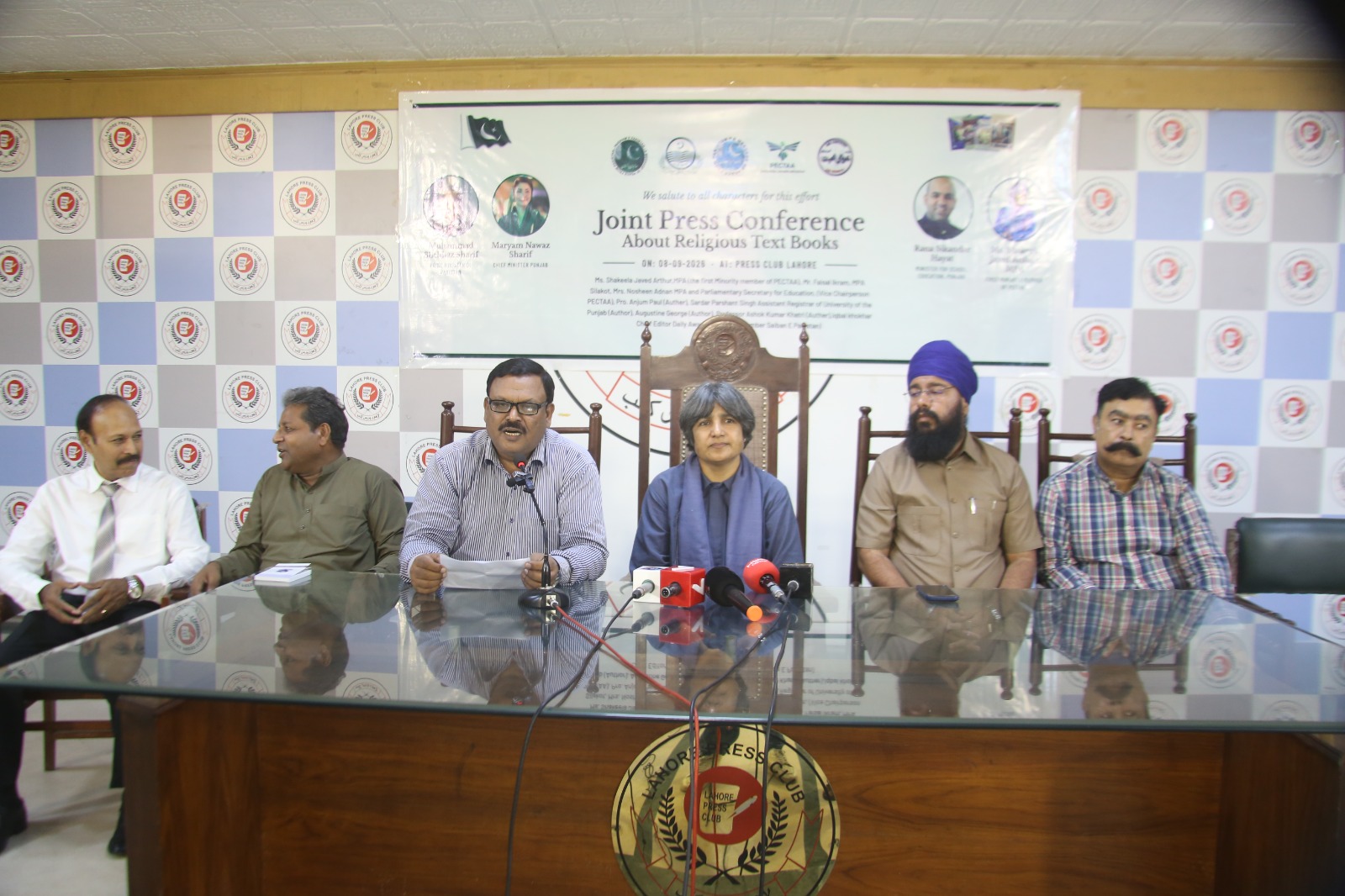
Lahore: Punjab Assembly Member and minority representative Shakeela Javed Arthur, the first minority member of the Punjab Curriculum and Textbook Assessment Authority (PECTAA), has welcomed the implementation of minority religion textbooks in schools across Punjab, calling it a historic step toward educational inclusion and equal rights for non-Muslim students.
Speaking at a press conference at the Lahore Press Club, Shakeela Javed Arthur was joined by authors of the newly developed minority religion textbooks, including Sardar Prashant Singh, Professor Ashok Kumar Khatri, Professor James Anjum Paul, Augustine George, and Saiban-e-Pakistan member Iqbal Khokhar.
Addressing journalists, Arthur said the textbooks have been officially implemented from the 2026-27 academic session and are designed to provide non-Muslim students with education according to their own faith traditions rather than requiring them to study ethics as an alternative subject.
She said the initiative reflects the vision of Pakistan’s founding principles and ensures that students belonging to minority communities can now learn about their own religions in a structured academic environment.
“Previously, ethics was taught as an alternative to Islamic Studies for non-Muslim students. Now, religious education has been introduced as a regular subject, enabling students from seven minority faiths — Christianity, Hinduism, Sikhism, Kalash, Baha’i, Zoroastrian (Parsi), and Buddhism — to study their respective religions and sit examinations in those subjects,” she said.
Arthur noted that minority communities across Pakistan have welcomed the move, describing it as a significant milestone in promoting equal educational opportunities and strengthening religious freedom.
She said the initiative would contribute to the promotion of peace, security, brotherhood, tolerance, interfaith harmony and national cohesion by recognizing the religious identities of all citizens within the education system.
Highlighting the background of the project, she explained that the need for minority religious education was emphasized during discussions surrounding the National Action Plan (NAP) and later incorporated into the broader objectives of Paigham-e-Pakistan, a national initiative aimed at promoting unity, tolerance and countering extremism.
The textbook authors also briefed the media on the development process and expressed satisfaction that years of advocacy and consultation had finally resulted in the implementation of dedicated religious education curricula for minority students.
Arthur praised the role of Punjab Chief Minister Maryam Nawaz Sharif and Provincial Minister for School Education Rana Sikandar Hayat, saying the project was implemented under their special instructions and close supervision.
She further emphasized that the achievement belonged to all individuals and institutions that had contributed to the effort over the years.
“Whoever played a role in making this initiative possible deserves appreciation and congratulations,” she said, adding that collective efforts had helped turn a long-standing demand of minority communities into reality.
Participants at the press conference described the introduction of minority religion textbooks as a landmark development in Pakistan’s education sector and an important step toward building a more inclusive and tolerant society.
No comments yet.