
The Makkah Pact: A New Geometry of Partnership
By Khurram Ali Raza
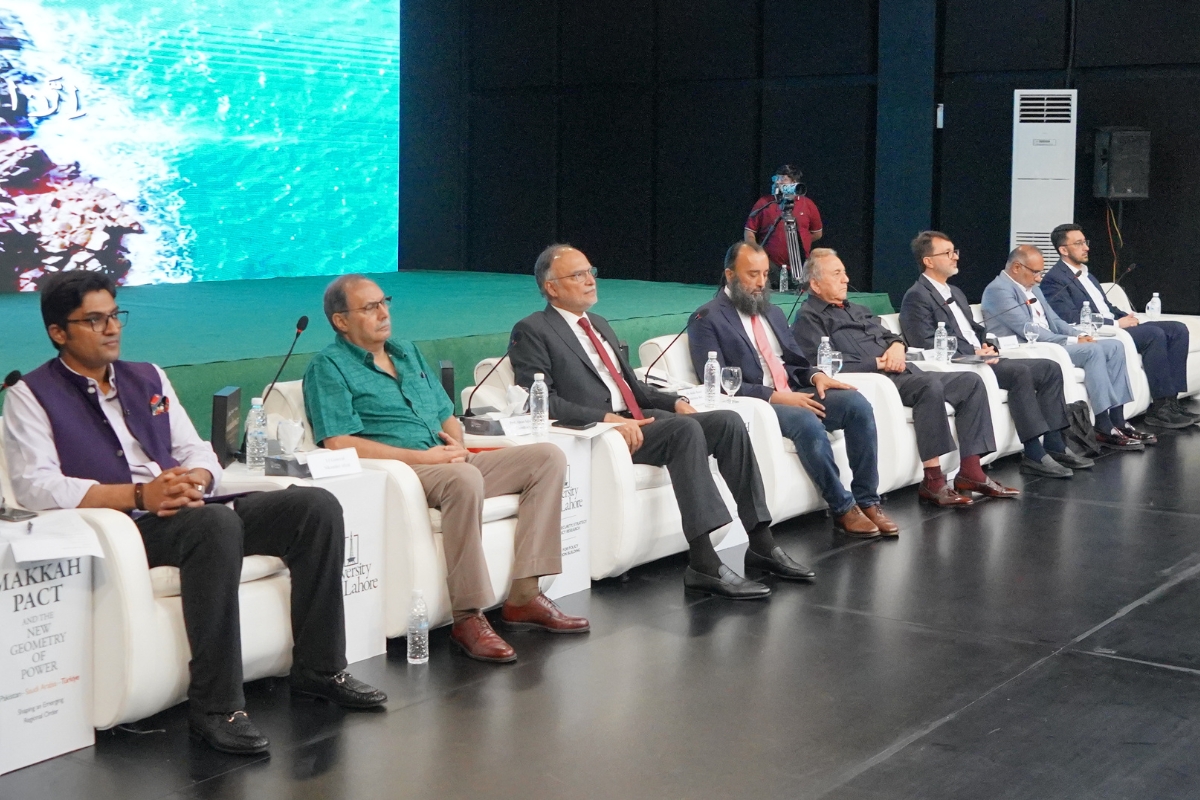
LAHORE — The Makkah Joint Defence Agreement between Pakistan, Saudi Arabia and Türkiye may have been born out of changing security realities, but its significance could extend far beyond the traditional language of defence, deterrence and military alliances.
Signed on August 7, 2026, the agreement points towards a changing geometry of regional relationships—one in which countries are increasingly looking beyond traditional alliances and seeking partnerships based on shared interests, complementary strengths and a common vision for the future.
For Pakistan, that development deserves to be viewed through a much wider lens.
The central question should not simply be how the Makkah partnership can strengthen collective defence. It should be whether the agreement can help Pakistan transform its strategic importance into economic strength, technological capability, human development and greater prosperity for its people.
That broader question was at the heart of a high-level international conference hosted by The University of Lahore (UOL) on September 3, 2026, where political leaders, diplomats, former ministers, military experts, academics, journalists, business leaders and scholars from Pakistan and Türkiye gathered to examine the implications of the newly formed Makkah Defence Alliance.

The conference provided an important reminder that the nature of power itself is changing.
Military strength remains essential. But in the 21st century, the countries that shape the international system will not necessarily be those with the largest armies. They will increasingly be the countries capable of educating their populations, developing advanced technologies, building competitive industries, attracting investment, expanding exports and creating resilient economies.
That is precisely where Pakistan must focus.
A New Strategic Geometry
The emergence of the Pakistan-Saudi Arabia-Türkiye partnership comes at a time when the international system is undergoing profound transformation.
The old architecture of global alliances is being challenged by new centres of economic and political influence. Regional powers are seeking greater strategic autonomy, while countries are increasingly diversifying their diplomatic, economic and security partnerships.
The Makkah Pact can therefore be understood not simply as another defence agreement, but as part of this larger transition.

Federal Minister for Planning and Development Ahsan Iqbal offered perhaps one of the most relevant observations during the UOL conference. He argued that the major battles of the 21st century will increasingly be fought not only on traditional battlefields, but in universities, laboratories, technology centres, factories and financial markets.
That observation should be central to Pakistan's thinking about the Makkah partnership.
The real strength of the three countries lies partly in what each can bring to the table.
Saudi Arabia possesses enormous financial resources, investment capacity and an ambitious economic transformation agenda. Türkiye has developed substantial industrial, manufacturing, defence and technological capabilities. Pakistan, meanwhile, has a large and youthful population representing enormous human potential.
Individually, these assets are significant.
Combined intelligently, they could become far more powerful.
But that will not happen simply because leaders sign agreements.
Partnerships succeed when political commitments are converted into institutions, projects, investment flows, research programmes, business opportunities and measurable outcomes.
For Pakistan, the challenge is therefore to move beyond celebrating the strategic dimension of the Makkah Pact and ask a much more practical question:
How can this partnership help build a stronger Pakistani economy?
From Capital to Capability
The answer may lie in connecting three critical elements: capital, technology and people.
Pakistan needs investment in industries capable of creating employment and increasing exports. It needs access to advanced technology and meaningful technology transfer. It needs joint research programmes, scholarships, vocational training, industrial partnerships and opportunities for Pakistani businesses to enter Saudi and Turkish markets.
There is enormous potential for cooperation in areas such as:
-
Artificial intelligence and digital technology
-
Cybersecurity and cyber infrastructure
-
Defence and advanced manufacturing
-
Renewable and conventional energy
-
Agriculture and food security
-
Critical minerals
-
Pharmaceuticals
-
Engineering and industrial production
-
Tourism and hospitality
-
Logistics and transport
-
Research and innovation
-
Higher education and vocational training
If developed strategically, such cooperation could give the Makkah partnership a meaning far broader than security.
It could turn a strategic relationship into an engine for development.
The second roundtable at the UOL conference, titled “Geo-Strategic and Economic Dividends,” directly addressed this question. Speakers emphasised the importance of technological capacity, tourism and trade between the three countries, while also warning that Pakistan must improve its internal systems if it wants to capture the benefits of foreign investment.
This is an uncomfortable but necessary conversation.
Friendly countries may be willing to invest in Pakistan. But investment requires an environment capable of absorbing and multiplying that capital. Bureaucratic inefficiency, regulatory uncertainty, weak implementation and institutional delays can undermine even the most promising international partnerships.
The Makkah Pact could create opportunities.
Pakistan must make itself capable of using them.
Pakistan’s Greatest Asset Is Its People
Perhaps the most important component of this equation is not oil, money, geography or military hardware.
It is human capital.
Pakistan's young population is frequently described as a demographic dividend. But demographics alone do not create prosperity.
A young population becomes a dividend only when people are educated, skilled, healthy, productive and connected to economic opportunity.
Otherwise, demographics can become a burden.
This is why the emphasis placed by conference speakers on education and human development deserves particular attention.
A country cannot become a technological power without scientists. It cannot become an industrial power without engineers and skilled workers. It cannot become a digital economy without programmers and technology entrepreneurs. And it cannot compete globally without managers, researchers, innovators and institutions capable of turning ideas into commercially successful products.
This places Pakistan's universities at the centre of the country's strategic future.
Universities must increasingly become places where ideas become innovation, research becomes products and knowledge becomes economic value.
The UOL conference itself offered an example of that potential by bringing policymakers, diplomats, military experts, business leaders, journalists and academics into the same space.
That kind of dialogue matters.
Pakistan's future strategic strength may be determined as much in classrooms, laboratories and technology incubators as in traditional security institutions.
Three Civilisational Partners
Former foreign minister Khurshid Mahmud Kasuri, while delivering the keynote address, placed the agreement in a broader historical context.

He highlighted the long-standing connections between Pakistan, Türkiye and the Arab world and described the three countries as “three civilisational partners.”
His observation is significant because strategic partnerships become more durable when they rest on more than immediate calculations.
History matters.
People-to-people connections matter.
Cultural understanding matters.
Public sentiment matters.
Kasuri argued that the Makkah Pact was different because it was not merely a product of decisions made by state leaders but also reflected sentiments among ordinary people.
That emotional and historical dimension can become an important foundation for deeper cooperation—provided it is matched by practical economic and institutional engagement.
Deterrence and the Search for Peace
The security dimension of the agreement remains fundamental.
Punjab Assembly Speaker Malik Muhammad Ahmad Khan expressed the hope that the pact would serve as an instrument for promoting regional peace through deterrence.

His argument was straightforward: when Pakistan, Saudi Arabia and Türkiye combine their respective strengths, the message is not necessarily one of confrontation but of preparedness.
A credible capacity for deterrence, supporters argue, can contribute to stability by raising the cost of aggression.
Former National Security Adviser Lieutenant General (retd) Nasir Janjua described the agreement as timely and carefully considered. He also said that Saudi Arabia and Türkiye had gained confidence from Pakistan's support and highlighted the agreement's importance for the broader security of the Muslim world.
Meanwhile, former Foreign Secretary Jalil Abbas Jilani viewed the pact as reflecting Pakistan's diplomatic achievements under the leadership of Prime Minister Muhammad Shehbaz Sharif and Chief of Defence Forces Field Marshal Asim Munir.

He emphasised that the agreement must be understood within the evolving strategic environment of the Middle East, a region that has faced significant security and political challenges in recent years.
Yet modern security cannot be separated from economic resilience.
A country with a strong economy, advanced technology, educated citizens, capable institutions and competitive industries is better positioned to protect its sovereignty and national interests.
In that sense, development itself becomes a form of strategic strength.
A Changing Global Balance
Former national security adviser Nasir Janjua also pointed towards a broader transformation in global power, arguing that the balance was shifting with the increasing influence of Russia, China and the Muslim world alongside what he described as the relative decline of the United States.
Whether one agrees fully with that assessment or not, the larger point is difficult to ignore: the international system is becoming more complex and less dominated by a single centre of power.
For countries such as Pakistan, this creates both risks and opportunities.
Greater regional cooperation can provide room for strategic autonomy.
But strategic autonomy does not mean strategic isolation.
Pakistan does not need to choose between the world's major powers in order to protect its interests. Nor should it become dependent on any single partner.
A more confident foreign policy can maintain strong relationships with multiple countries while simultaneously developing domestic economic and technological capabilities.
The principle articulated by Ahsan Iqbal—“friendship with all and dependence on none”—offers a useful framework.
Pakistan should seek partnerships everywhere its national interests are served, while ensuring that those partnerships strengthen rather than replace its own capabilities.
The University as a Strategic Institution
UOL Chairman Awais Raoof also made an important contribution to the discussion by stressing the responsibility of universities to provide platforms for meaningful debate, particularly at a time when the global order and respect for human rights are under pressure.

He described the emergence of the Makkah Pact as welcome news and characterised it as defensive in nature, while suggesting that it could represent the beginning of a new regional security structure.
He also noted that other countries had expressed interest in joining the framework.
That possibility makes the question of the alliance's long-term identity even more important.
Participants at the conference cautioned against automatically labelling the partnership as an “Islamic NATO.”
That terminology may be attractive for headlines, but it risks reducing a potentially sophisticated regional partnership to a Western historical analogy.
The Makkah partnership does not need borrowed labels.
Its significance will ultimately be determined by what it achieves.
If it strengthens deterrence, promotes peace, facilitates economic integration, encourages technological cooperation and creates opportunities for ordinary citizens, it will develop an identity of its own.
Connectivity Must Mean More Than Roads
The Makkah partnership also gives Pakistan an opportunity to rethink the meaning of regional connectivity.
Connectivity is often discussed in terms of highways, ports, trade routes and investment corridors.
Those remain important.
But the next generation of connectivity will also be digital, educational and technological.
A Pakistani university collaborating with a Turkish research institution can create connectivity.
A Pakistani technology company entering the Saudi market can create connectivity.
A joint artificial-intelligence research programme can create connectivity.
A vocational training partnership can create connectivity.
A Pakistani agricultural enterprise exporting processed food to Saudi Arabia can create connectivity.
A Saudi investment fund financing Pakistani manufacturing can create connectivity.
The new geometry of regional partnership is therefore not simply geographical.
It is economic, technological, educational and human.
Pakistan Must Win the Battle for Development
Ahsan Iqbal's description of Pakistan's challenge as a “battle for development” may ultimately prove more important than any discussion about the country's strategic geography.
Pakistan has long been described as strategically important because of its location.
That geography will not disappear.
But geography alone does not produce prosperity.
A strategically located country without competitive industries, strong institutions, human capital and technological capacity can remain strategically important without becoming economically powerful.
Pakistan must make the transition from one to the other.
That means increasing exports.
It means improving productivity.
It means investing in education.
It means reforming institutions.
It means supporting innovation.
It means developing technology.
It means creating an environment in which domestic and foreign investors can operate with confidence.
And, above all, it means creating opportunities for young Pakistanis.
From Strategic Importance to Economic Power
The house resolution adopted at the UOL conference reflected this broader understanding, linking the Makkah Pact with peace, deterrence, strategic autonomy, economic resilience, diplomacy and shared prosperity.
That may be the most useful way to understand the agreement.
The Makkah Pact should not be judged solely by the strength of its defence arrangements.
Its larger test will be whether it can open doors for investment, education, technology, trade and human development.
For Pakistan, the opportunity is significant.
Saudi Arabia can provide capital and investment.
Türkiye can offer industrial and technological expertise.
Pakistan can contribute human capital, geographic connectivity, a large consumer market and a substantial pool of young talent.
But these strengths must be deliberately connected.
A trilateral framework without economic implementation will remain primarily a security arrangement.
A trilateral framework that creates research centres, industrial partnerships, technology transfer, scholarships, investment projects, export opportunities and employment could become something much more consequential.
That is where Pakistan's policymakers should focus.
The Makkah Pact should not merely protect borders.
It should help build capabilities.
It should not only strengthen deterrence.
It should strengthen development.
It should not simply create a new strategic bloc.
It should create new opportunities for businesses, universities, researchers, workers and young people.
The Real Measure of Success
The geometry of regional partnerships is changing.
Pakistan now has an opportunity to help shape that geometry rather than simply respond to it.
But the ultimate measure of success will not be found in diplomatic ceremonies, communiqués or military symbolism.
It will be found in the lives of ordinary people.
Does the partnership create new industries?
Does it generate jobs?
Does it increase Pakistani exports?
Does it bring technology into the country?
Does it expand opportunities for students and researchers?
Does it attract productive investment?
Does it improve energy and food security?
Does it help Pakistani companies access Saudi and Turkish markets?
Does it make Pakistan more productive and competitive?
If the answer to these questions becomes yes, then the Makkah Pact will have achieved something far greater than a new defence arrangement.
It will have helped Pakistan move from being a country whose strategic importance is frequently discussed to one whose economic power commands equal attention.
That is the opportunity before Pakistan.
The country's strategic relationships are changing. Its regional partnerships are evolving. The global balance is shifting.
Pakistan should seize this moment not merely to strengthen its position in the security architecture of the region, but to build the economic and technological foundations of its future.
The real promise of the Makkah Pact, therefore, may not lie only in the strength of the three countries standing together.
It may lie in what they can build together.
And for Pakistan, that is where partnership can finally become progress.
No comments yet.