
A Turning Point in Islamabad–Washington Relations
Editorial
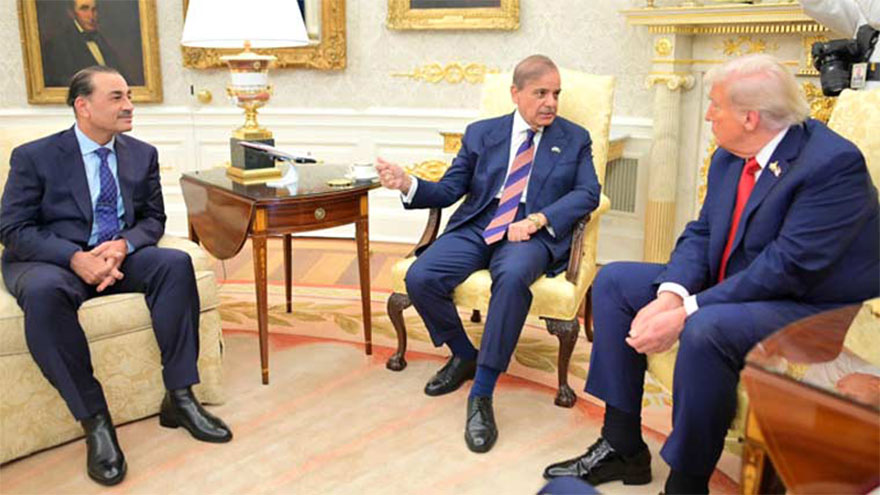
The recent Oval Office meeting between U.S. President Donald Trump, Prime Minister Shehbaz Sharif, and Pakistan’s Chief of Army Staff, Field Marshal Asim Munir, marks a significant moment in the history of Pakistan–U.S. relations. Far from being a routine diplomatic encounter, it signals the possibility of a long-overdue reset between two nations whose cooperation has often determined the balance of regional stability.
For years, ties between Islamabad and Washington have ebbed and flowed—shaped by war, security crises, and shifting alliances. Yet, the atmosphere in Washington last week carried a sense of renewal. The inclusion of both Pakistan’s civilian leadership and its military chief underlined unity at home and seriousness abroad. That alone sends a powerful message: Pakistan is ready to engage with America as a cohesive, confident partner.
President Trump deserves credit for recognizing this moment. His decision to host both Prime Minister Sharif and Field Marshal Munir together demonstrates a clear understanding of Pakistan’s unique political and institutional structure. By praising his Pakistani counterparts as “great leaders,” Trump offered not just courtesy but respect—something Pakistan has too often found absent in past dealings with Washington.
Field Marshal Munir’s participation carried particular weight. The Pakistani military has long played a central role in regional security, and Munir’s leadership has already won him recognition as a steady and pragmatic voice. His presence at the White House reflected Pakistan’s seriousness in pursuing a strategic partnership built on more than rhetoric.
The substance of the meeting should not be overlooked. Agreements on minerals and rare earth elements—backed by a $500 million U.S. investment—signal a shift from aid-driven ties to opportunity-driven cooperation. Trump’s earlier pledge to support Pakistan’s oil development only strengthens this emerging framework. It is a reminder that Pakistan’s natural resources, when paired with American capital and technology, can anchor a mutually beneficial future.
Skeptics may call this symbolism, but in diplomacy, symbols matter. The warmth of the Oval Office encounter, the unity of Pakistan’s civilian and military leadership, and Trump’s willingness to recalibrate U.S. policy all point to a relationship entering a healthier phase.
This is a turning point worth seizing. For Pakistan, it offers the chance to move beyond dependency and assert itself as a reliable partner in trade, energy, and security. For the United States, it provides a stable ally in a turbulent region and access to resources vital for the industries of tomorrow.
The task ahead is clear: transform the goodwill of this meeting into concrete action. If both sides follow through, history may look back at this Oval Office moment as the spark that reignited a natural alliance.
No comments yet.