
President Zardari Strengthens Pakistan China Partnership
Editorial
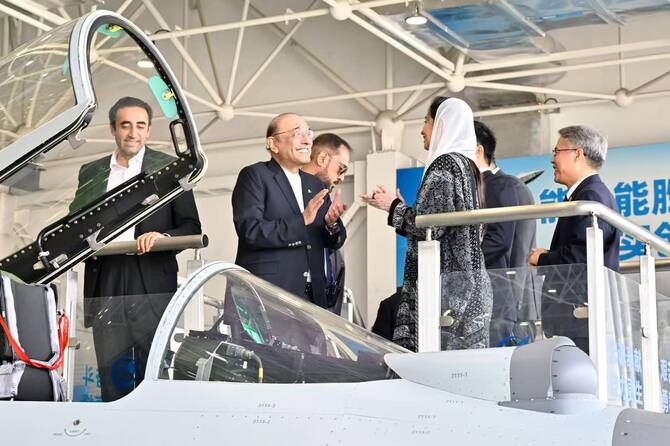
Pakistan’s relationship with China has long been described as an “all-weather friendship.” More than rhetoric, this bond is a cornerstone of Pakistan’s strategic and economic outlook. In recent weeks, President Asif Ali Zardari’s visit to China reaffirmed both the strength of this partnership and his own role in shaping its trajectory.
During his presidency from 2008 to 2013, Zardari recognized that Pakistan’s stability could not rest solely on political goodwill. It required deep, structured economic cooperation with Beijing. His record number of visits to China helped build enduring trust with Chinese leadership and led to transformative agreements, including the initial framework of the China-Pakistan Economic Corridor (CPEC). His decision to transfer Gwadar Port’s operational control to a Chinese company was equally pivotal, establishing Pakistan as a hub of regional connectivity and positioning it firmly within the Belt and Road vision.
The recent visit to Urumqi reflected both continuity and expansion of this vision. Meeting Xinjiang’s Communist Party Secretary Chen Xiaojiang, President Zardari stressed that stronger linkages between Xinjiang and Pakistan’s northern areas would deepen both cultural and economic ties. He expressed hope that one day the two countries would be seamlessly connected by road, enhancing trade and people-to-people exchanges.
On this occasion, Islamabad reaffirmed its commitment to working with Beijing against terrorism and extremism, while broadening cooperation into agriculture, livestock, mining, manufacturing, and emerging technologies. Three significant MoUs were signed between Chinese and Pakistani enterprises—covering livestock development, textile industries, and emergency services—marking new opportunities for growth and job creation.
This visit was not confined to state-to-state dealings. It also carried immense provincial significance. President Zardari and PPP Chairman Bilawal Bhutto Zardari highlighted that major projects in Sindh, including Thar Coal, the Karachi Circular Railway, mass transit systems, and industrial zones, will be realized with China’s cooperation. These projects promise to transform Sindh’s economy while creating thousands of new jobs across Pakistan.
The president was accompanied by First Lady Bibi Aseefa Bhutto Zardari, PPP Chairman Bilawal Bhutto Zardari, Senator Saleem Mandviwalla, Sindh ministers Sharjeel Memon and Syed Nasir Shah, alongside Chinese Ambassador Jiang Zaidong and Pakistan’s envoy Khalil Hashmi. Their presence underlined the collective nature of this outreach and the significance attached to the mission.
Zardari also reflected on China’s remarkable journey, noting that the Communist Party’s memorial in Urumqi symbolizes a nation’s transformation into a global power. He praised President Xi Jinping’s visionary leadership for guiding that process—a subtle reminder of the importance of long-term vision in shaping national destiny.
In many ways, this visit encapsulates Zardari’s political legacy. As his presidency had first laid the foundations of CPEC, this renewed engagement shows how leadership can sustain momentum beyond political cycles. Today, discussions on “CPEC 2.0”—from upgrading railways to exploring cooperation in green technology—stand firmly on the groundwork he initiated.
The visit was more than ceremonial; it was a statement of continuity and purpose. Quaid-e-Azam, Shaheed Zulfikar Ali Bhutto and Shaheed Benazir Bhutto left indelible marks on Pakistan’s history, Zardari has cemented his place as the architect of Pakistan’s modern partnership with China. His leadership has provided Pakistan not only with a steadfast ally but also with a clear path to economic revival and regional prominence.
President Asif Ali Zardari has once again demonstrated that Pakistan-China relations are not merely diplomatic tradition—they are a living, evolving partnership with the power to shape the future. sentences), or keep it at this longer editorial depth?
No comments yet.